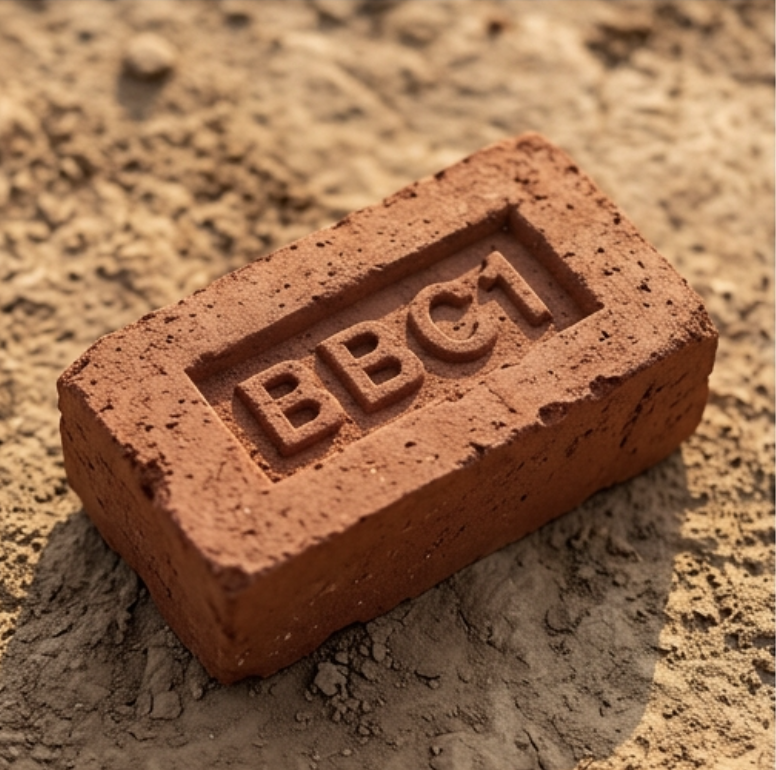
The construction materials market now offers several alternatives to traditional burnt clay bricks. Here is a factual comparison based on IS standards, field experience, and cost data relevant to North India construction.
Side-by-Side Comparison
| Property | Burnt Clay Brick (Zigzag) | AAC Block | Fly Ash Brick |
|---|---|---|---|
| Standard | IS 1077 | IS 2185 Part 3 | IS 12894 |
| Compressive strength | 50–75 kg/cm² | 30–50 kg/cm² | 70–100 kg/cm² |
| Density | 1800–2000 kg/m³ | 550–700 kg/m³ | 1700–1850 kg/m³ |
| Water absorption | 12–16% | 25–40% | 8–12% |
| Thermal conductivity | 0.6–0.8 W/mK | 0.16–0.24 W/mK | 0.7–0.9 W/mK |
| Cost per sq ft wall | ₹45–55 | ₹50–65 | ₹40–50 |
| Availability (rural) | High | Low | Moderate |
Where Burnt Clay Bricks Win
- Load-bearing construction: Burnt clay bricks handle compressive loads more predictably than AAC
- Water resistance: Clay bricks perform better in areas with monsoon exposure or rising damp
- Availability: Widely available in Tier 2/3 cities and rural areas where AAC suppliers don't deliver
- Mason familiarity: Local masons know how to work with clay bricks. AAC requires different tooling and techniques
- Nail and anchor holding: Clay bricks hold fasteners without special anchors required by AAC
Where Alternatives Win
- AAC excels in high-rise construction (lighter dead load), thermal insulation, and urban projects where speed matters (larger blocks = fewer courses)
- Fly ash bricks offer excellent dimensional consistency, higher strength, and environmental benefit of using industrial waste
Practical Recommendation
For most residential and small commercial projects in Haryana, Rajasthan, and Punjab — especially in semi-urban and rural areas — burnt clay bricks from a Zigzag kiln remain the most practical, cost-effective, and locally serviceable choice. AAC blocks make sense for urban high-rise and projects prioritising thermal insulation.
BBC1 produces IS 1077-compliant Zigzag kiln bricks. Compare our prices against alternatives for your project: Get a Quote.